The United States ranked 39th out of 149 countries on an environmental performance list which evaluates sanitation, greenhouse gas emissions, agricultural policies, air pollution and 20 other measures. The U.S. scored an 81 out of a possible 100. The four countries at the top of the list were Switzerland, Sweden, Norway and Finland, which received scores of 87 or higher. Switzerland's high scores for greenhouse gas efficiency can be, at least partly, attributed to its use of hydroelectric power and its transportation system, which relies heavily on trains.
This list was first created in 2002 from research done by Yale and Columbia Universities. The 2007 list will be released this month at the World Economic Forum in Switzerland. Daniel Esty, one of the reports authors, notes that the U.S. received low scores on three different greenhouse gas emission categories as well as a smog indicator. Another researcher noted that a country's wealth correlated with high scores on sanitation and disease control, but low scores on greenhouse gas emissions and agricultural policies.
Wednesday, January 23, 2008


Monday, January 21, 2008
Reagan Remembered
Some of Ronald Reagan's more memorable quotes:
"The most terrifying words in the English language are: I'm from the government and I'm here to help."
"I have wondered at times about what the Ten Commandments would have looked like if Moses had run them through the U.S. Congress."
"The taxpayer: That's someone who works for the federal government but doesn't have to take the civil service examination."
"The nearest thing to eternal life we will ever see on this earth is a government program."
"Government's view of the economy could be summed up in a few short phrases: If it moves, tax it. If it keeps moving, regulate it. And if it stops moving, subsidize it."
"No arsenal, or no weapon in the arsenals of the world, is as formidable as the will and moral courage of free men and women."
"If we ever forget that we're one nation under God, then we will be a nation gone under."
Thursday, January 17, 2008
Wetlands Restoration Could Reduce Dead Zone
The Gulf of Mexico at the mouth of the Mississippi River has a dead zone of approximately 975 square miles. That would cover 80% of the state of Rhode Island. This dead zone is an area of low-oxygen water created by extreme amounts of nutrients such as phosphorus and nitrogen. These nutrients typically come from fertilizers applied to farm fields and lawns which are then washed into the Mississippi River and flushed directly into the Gulf of Mexico. The nutrients rob the water of oxygen making it unsuitable for plants and animals in an area that makes up a large portion of the nations fishing grounds.
As wetlands are lost, this dead zone grows. Wetlands typically filter out these excess nutrients and provide fresh, oxygen-rich water to the Gulf of Mexico; however, Louisiana is losing a football field of wetlands every 38 minutes. Researchers are working furiously to restore balance to this fragile ecosystem. Wetlands are being developed upstream of the Gulf Coast to help reduce nutrient loads entering the Mississippi River and restoration efforts abound along the coast. Rebuilding wetlands along Louisiana's coast not only benefits water quality, but also provides invaluable hurricane protection by reducing storm surge and, in turn, reducing potential stresses on levees.
As wetlands are lost, this dead zone grows. Wetlands typically filter out these excess nutrients and provide fresh, oxygen-rich water to the Gulf of Mexico; however, Louisiana is losing a football field of wetlands every 38 minutes. Researchers are working furiously to restore balance to this fragile ecosystem. Wetlands are being developed upstream of the Gulf Coast to help reduce nutrient loads entering the Mississippi River and restoration efforts abound along the coast. Rebuilding wetlands along Louisiana's coast not only benefits water quality, but also provides invaluable hurricane protection by reducing storm surge and, in turn, reducing potential stresses on levees.
Tuesday, January 15, 2008
Sewage Restores Wetlands
Dr. Gary Shaffer, an environmental scientist at Southeastern Louisiana University, is working toward restoring Louisiana's wetlands...using sewage. Sewage from the city of Hammond is treated and then piped seven miles to an area known as 4-Mile Marsh. The sewage effluent is clean, but still high in nutrients such as phosphorus and nitrogen. The wastewater is released into the marsh where cypress trees, tupelo trees, grasses and other plants absorb the nutrients. Approximately one month after wastewater is released from the pipline, it leaves the marsh system cleaner than it used to leave the treatment plant.
The Hammond pipeline cost $7 million, but saves the city $2 million a year by eliminating the final stage of sewage treatment. 4 million gallons per day of sewage effluent are pumped into 4-Mile Marsh. The nutrients feed the wetland plants and the plants clean the water. It's a perfect symbiotic relationship.
Numerous experiments are being conducted at 4-Mile Marsh to determine the most effective techniques for restoring the coastal wetlands. Plant species, growth techniques and plant spacing are all being tested. EMIP® cypress trees were planted alongside bare root and container grown trees in the spring of 2007 and growth and survival rates were measured after the first growing season. EMIP® cypress trees out performed the bare root and container grown trees by leaps and bounds. EMIP® cypress trees had almost 100% survival and increased in basal diameter four times more than other trees. Some EMIP® trees grew so much that they became top heavy and fell over in the wet soils; however, the ones that were righted before nutria could eat the roots seem to be recovering well. EMIP delivered 600 additional cypress trees to 4-Mile Marsh this month to be used in experiments testing the most effective tree spacing for maximum nutrient absorption.
 Sewage Effluent Released into 4-Mile Marsh
 Plastic Sleeves Protect Saplings in 4-Mile Marsh

Plastic Sleeves Protect Saplings in 4-Mile Marsh

EMIP® Cypress Trees Delivered for Placement in 4-Mile Marsh
Sunday, January 06, 2008
Lesson Learned?
On August 29, 2005, Hurricane Katrina hit the Gulf Coast. Two and a half years later, have we learned any lessons? Hopefully, the next administration will promote the restoration of the wetlands to help prevent this from happening again.


Thursday, January 03, 2008
2007 - The "Green" Year
Green was the color for 2007. Consumers converted to compact florescent lightbulbs and hybrid cars, corporate america reduced greenhouse gas emissions before legislation required reductions and politicians rallied around solutions to global warming. Green even moved into the world of rock with Al Gore's first ever Live Earth concert intended to raise awareness of environmental issues. The question is, will these trends continue?
In December, Congress passed the first increase in Corporate Average Fuel Economy standards in thirty years. Automakers will have to produce cars and light trucks which get an average of 35 miles per gallon by 2020, up from the current standard of 27.5. Congress is also working to pass a bill cutting greenhouse gas emissions. We may even see the environment appear in upcoming presidential debates.
In December, Congress passed the first increase in Corporate Average Fuel Economy standards in thirty years. Automakers will have to produce cars and light trucks which get an average of 35 miles per gallon by 2020, up from the current standard of 27.5. Congress is also working to pass a bill cutting greenhouse gas emissions. We may even see the environment appear in upcoming presidential debates.
Sunday, May 13, 2007
Rainforest Woes
The Ugandan government is attempting to give 17,500 acres of rainforest the axe. Literally. They intend to revoke the protected status of a portion of the Mabira Forest and give the land to a sugar cane company for clearing. Only about 15% of Uganda's land is still forested and approximately 2% of those forests are lost each year to clearing for farming and cattle. The forests mean life to the locals, providing firewood, charcoal, herbal medicine, edible fruits and timber. A recent study has shown that nine species of wildlife found only in the Mabira Forest, including a shrub used to treat malaria, would be in danger of extinction.
The rainforest is already disappearing at an alarming rate without government's actually offering up protected areas for deforestation. If only 15% of the entire country is forested, there shouldn't there be plenty of places that are already cleared and suitable for sugar cane?
The rainforest is already disappearing at an alarming rate without government's actually offering up protected areas for deforestation. If only 15% of the entire country is forested, there shouldn't there be plenty of places that are already cleared and suitable for sugar cane?
Saturday, May 12, 2007
Green Rebuilding Efforts
A rebuilding project in New Orleans' Lower Ninth Ward is focusing on green techniques. Global Green USA is the environmental group building the project, which is being largely funded by the Home Depot Foundation. The project consists of five shotgun style homes and an 18-unit housing complex that will utilize 40% less energy than traditional buildings. Project sponsors and supporters hope that this can be seen as a template for other rebuilding efforts.
Tuesday, May 01, 2007
Living Rivers
You can't fight Mother Nature. For years, people have tried to make nature conform to their needs and desires; often times with disasterous consequences. Nowhere is this mindset more evident than in rivers and streams. People have moved, straightened, widened, deepened and bound waterways for a multitude of reasons, but to prevent flooding has always been near the top of the list. They seem to forget that floodplains were aptly named because rivers need to flood.
Rivers are a living, dynamic system to which flooding is like breath. The rivers may not take a breath as often as we humans do, but without it they too will certainly choke. Flooding releases sediment to the floodplains that would otherwise fill river beds. Flooding also provides nutrients to floodplain soils and replenishes wetlands. A healthy river is considered to be in a state of dynamic stability. It lives in a fairly definable corridor, within which meanders migrate, cutoff and reform as water and sediment are carried downstream.
I wish more people appreciated the natural beauty of a river. From headwaters to outlet, it maintains a delicate balance of flow and sediment and nourishes so many adjacent habitats. The studies of river hydraulics and geomorphology have allowed us to begin to understand the complex interactions of this system. Great researchers in this field, such as Luna B. Leopold and Dave Rosgen, have brought us closer to the goal of living with rivers instead of against them.
Monday, April 30, 2007
Trees Have Monetary Value
Some people have always known that trees have value, but now a dollar value has been put on them.
Now, for the first time, the [New York City] Parks Department can actually translate the value of the city’s trees into real dollars and cents. And as expected, it’s a big number.
Step 1 was a tree census, a two-year process that sent more than 1,000 volunteers to count every tree on every street in the [New York] city. The census results were then fed into a computer program that spit out a dollar value for each of the 592,130 trees counted, a figure that does not include the roughly 4.5 million trees in parks and on private land.
The program, called Stratum, was developed by researchers at the University of California at Davis and the United States Forest Service. It takes into account several factors, including a tree’s impact on local property values, its contribution to cleaning the air by absorbing carbon dioxide, and how much its shade helps reduce energy consumption.
Factoring in the costs associated with planting and upkeep, New York City’s street trees provide an annual benefit of about $122 million, according to the Parks Department. The study concludes that New York receives $5.60 in benefits for every dollar spent on trees.
Considering the enhanced root system of EMI trees absorbs 18x more carbon dioxide than other trees, I'd like to see their benefit / cost ratio.
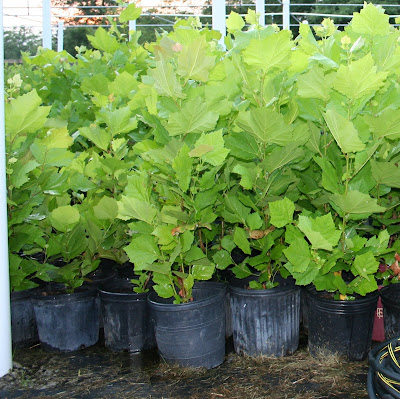
EMI Sycamore Trees Ready for Planting
Saturday, April 28, 2007
Amazon Versus Chevron
Approximately 30,000 Amazonian Indians and settlers are suing Chevron Corp. for failing to clean up billions of gallons of wastewater in Ecuador. Texaco Petroleum Co., which merged with Chevron in 2001, spent 30 years drilling for oil and dumping more than 18 billion gallons of oily wastewater in the rainforest.
The Indians are claiming that the oil company caused 30 times more damage than the Exxon Valdez oil spill, for the lands are now too oily to cultivate and cancer rates are elevated. They claim that when Texaco ceased drilling operations, their cleanup consisted of simply dumping dirt over contaminated soil and ponds. Chevron's lawyers claim that all cleanup efforts complied with Ecuadorean environmental laws.
The case is currently being heard in an Ecuadorean court after 10 years of failure to get Big Oil in a US court. Chevron has flat refused to settle out of court and a decision is not expected before next year.
Wednesday, April 25, 2007
Longleaf Pine Restoration
The US Army Corps of Engineers at Allatoona Lake has revived a natural ecosystem that was once native to the land surrounding the lake. Due to farming on the land prior to creation of the lake, the Longleaf pine ecosystem was transformed to a forest of more aggressive Loblolly and Virginia pines. Longleaf pine offers more benefits to wildlife and, in fact, offers such diversity that it serves as host to unique communities of plants and wildlife. Corps of Engineers personnel removed the competing pines and recreated the natural ecosystem through replanting and emulating wildfire. This undertaking took place on approximately 60 acres of the Allatoona Wildlife Management Area in Cherokee County near the border of Bartow County and has been so successful that the restoration will be expanded to almost 350 acres.
 While this project is great for Allatoona Lake, it will hardly make a dent in the millions of acres of longleaf pine ecosystem that have been lost in the last 50 years. Many other parks and refuges are also planning longleaf pine restorations.
Sunday, April 22, 2007
Thursday, April 19, 2007
Fly Green
Delta Airlines joins the numerous companies that are going green. Delta's Force for Global Good program allows customers to add a donation to any ticket purchase that will fund tree planting projects in managed forests around the world to offset carbon emissions. 100 percent of donations will be disbursed to the Conservation Fund's Carbon Sequestration Program. To date, the Conservation Fund has restored 30,000 acres with 9 million trees.
Tuesday, April 17, 2007
Shrinking Ice, Shrinking Hunting Grounds
Native villagers in northern Canada and the Arctic are receiving visitors they've never seen before. Warmer temperatures and warmer waters have sent animals such as finches, robins and dolphins into places where they have no name. This warmer atmosphere has also meant ice freezes later and thinner, forcing villagers to travel further to hunting grounds they once accessed by ice.
Hunting has also become more dangerous. Less snow has made it difficult to build igloos for shelter and thinning ice has claimed the lives of seasoned hunters. Knowledge that has been passed down for thousands of years about how to survive in these harsh conditions is no longer functional. Many elders refuse to even go out on the ice.
While Americans are responsible for one-fourth of the emissions that scientists attribute to global warming, these simple people who lived off the land for generations are feeling the affects. Everyone needs to do their part to reverse the effects of global warming.
Monday, April 16, 2007
Wind Power
Durango, Colorado city government has signed a contract to convert from 10% to 100% wind-generated power. Supplying energy from wind turbines will come at a yearly additional cost, which should be offset by energy efficiency credits and customers' agreement to pay an additional $1.25 per 100 kilowatt-hours per month.
Saturday, April 07, 2007
Valley Park Restoration
Valley Park, Missouri
 This narrow, high velocity stream was experiencing severe erosion. Portions of the bank were lined with riprap for protection.
 Other portions of the bank were lined with sandbags filled with air-pruned grasses interspersed with air-pruned trees. The sandbags hold soils in place long enough for the grass and tree root systems to become established. Then, air-pruned root systems hold soils in place and the grasses and trees provide roughness which dissipate energy.
 Bank roughness from grasses and trees dissipates energy, which slows velocities and allows sediments to drop out of flow building banks instead of eroding them.
 This narrow, high velocity stream was experiencing severe erosion. Portions of the bank were lined with riprap for protection. Other portions of the bank were lined with sandbags filled with air-pruned grasses interspersed with air-pruned trees. The sandbags hold soils in place long enough for the grass and tree root systems to become established. Then, air-pruned root systems hold soils in place and the grasses and trees provide roughness which dissipate energy. Bank roughness from grasses and trees dissipates energy, which slows velocities and allows sediments to drop out of flow building banks instead of eroding them.
Sunday, April 01, 2007
Lights Out for Change
Saturday night was the night that the lights went out in Sydney. At 7:30, homes, businesses and even famous skyline landmarks like the Sydney Opera House went dark for one hour to raise awareness about global warming and the steps that can be taken to help. Australia, with it's 21 million residents, is ranked the world's number 1 greenhouse gas emitter per capita.
Earth Hour was organized by environmentalists as the kick off to a campaign asking Sydney residents to turn off lights, computers and other electrical equipment when not in use which could reduce gas emissions by 5% a year. Scientists estimate that, without change, temperatures in Australia could rise 6.7 degrees by the year 2080, bringing more of the catastrophic weather conditions that have plagued the world in the last decades.
Sydney is not the first city to put the lights out for change. Paris, Rome and Athens have held similar conservation initiatives.
Monday, March 12, 2007
Amphibian Ark
A fungus threatens the world's amphibian populations. The fungus originated in Africa and has been spread around the world by the African clawed frog. Numerous amphibian species from Australia to Costa Rica have already become extinct and some in the US are close. 85% of the mountain yellow-legged frog populations in Yosemite National Park are infected.
Amphibians have been found to produce chemicals that serve biomedical purposes such as pain relievers and potential uses in AIDS prevention.
The group, Amphibian Ark, is trying to prevent the world's ponds and lakes from becoming silent by having zoos, botanical gardens and aquariums take in 500 endangered amphibians to protect them from the fungus. Once the fungus can be eradicated, these amphibians would be reintroduced into the wild.
Sunday, March 11, 2007
Lose Carbon, Win Cash
Sir Richard Branson, chairman of the Virgin Group, announced the Virgin Earth Challenge, a $25 million dollar prize to anyone who can develop a method to extract one billion tons of carbon dioxide per year. The world's leading climate scientists have warned that global warming is getting worse, and emissions of carbon dioxide are a major cause.
Contest entries will be judged by Branson, former Vice President Al Gore and numerous climate experts. The contest will stand for 5 years, but if no winner is identified, the contest may be extended. The winner's method must remove one billion tons of carbon dioxide from the atmosphere for 10 years. $5 million will be awarded at the start and the remaining $20 million at the end of the 10 year period.
The Earth cannot wait forever for a solution to global warming. "We need everybody capable of discovering an answer to put their minds to it today," said Branson.
Subscribe to:
Posts (Atom)