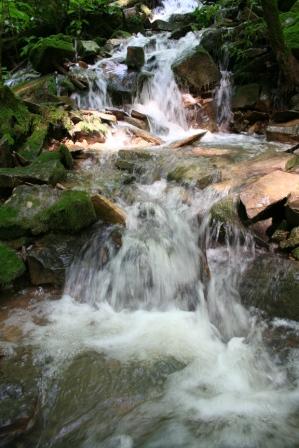
Currently, there are more than 37,000 river restoration projects ongoing across the United States. Over $1 billion is spent annually to help combat the years of abuse that our country's rivers have endured. Water pollution, overconsumption, development and deforestation are just a few of the things that have led to a serious need to nurse our river systems back to health.
An integral part of almost all river restoration projects is the planting of native trees, bushes and grasses to protect river banks, provide food and shelter for wildlife, slow runoff waters to reduce flooding risks and purify runoff waters before they reach an open channel condition and are carried downstream. EMIP hopes to become a leader in providing hearty trees and plants and generating innovative planting and protection techniques for these fragile, life-giving systems.
During the 1800s, gold was the most sought after commodity in the Western United States. Today, water is probably more precious than gold. The term "Water Wars" is not unfamiliar to the inhabitants of the West. During years of drought, the same battles have been fought in the Southeastern United States. In 2007, Lake Lanier in northern Georgia reached record lows after 50 years of operation and many rivers and streams ran low or dry throughout the year.
Showing posts with label trees. Show all posts
Showing posts with label trees. Show all posts
Monday, May 12, 2008


Monday, April 30, 2007
Trees Have Monetary Value
Some people have always known that trees have value, but now a dollar value has been put on them.
Now, for the first time, the [New York City] Parks Department can actually translate the value of the city’s trees into real dollars and cents. And as expected, it’s a big number.
Step 1 was a tree census, a two-year process that sent more than 1,000 volunteers to count every tree on every street in the [New York] city. The census results were then fed into a computer program that spit out a dollar value for each of the 592,130 trees counted, a figure that does not include the roughly 4.5 million trees in parks and on private land.
The program, called Stratum, was developed by researchers at the University of California at Davis and the United States Forest Service. It takes into account several factors, including a tree’s impact on local property values, its contribution to cleaning the air by absorbing carbon dioxide, and how much its shade helps reduce energy consumption.
Factoring in the costs associated with planting and upkeep, New York City’s street trees provide an annual benefit of about $122 million, according to the Parks Department. The study concludes that New York receives $5.60 in benefits for every dollar spent on trees.
Considering the enhanced root system of EMI trees absorbs 18x more carbon dioxide than other trees, I'd like to see their benefit / cost ratio.
Now, for the first time, the [New York City] Parks Department can actually translate the value of the city’s trees into real dollars and cents. And as expected, it’s a big number.
Step 1 was a tree census, a two-year process that sent more than 1,000 volunteers to count every tree on every street in the [New York] city. The census results were then fed into a computer program that spit out a dollar value for each of the 592,130 trees counted, a figure that does not include the roughly 4.5 million trees in parks and on private land.
The program, called Stratum, was developed by researchers at the University of California at Davis and the United States Forest Service. It takes into account several factors, including a tree’s impact on local property values, its contribution to cleaning the air by absorbing carbon dioxide, and how much its shade helps reduce energy consumption.
Factoring in the costs associated with planting and upkeep, New York City’s street trees provide an annual benefit of about $122 million, according to the Parks Department. The study concludes that New York receives $5.60 in benefits for every dollar spent on trees.
Considering the enhanced root system of EMI trees absorbs 18x more carbon dioxide than other trees, I'd like to see their benefit / cost ratio.
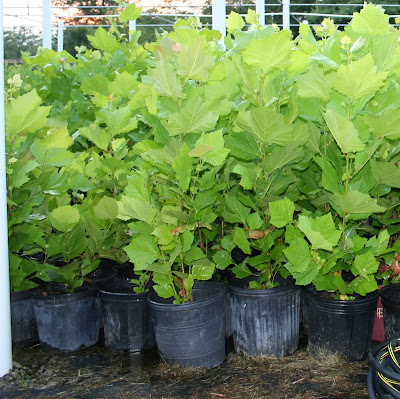
EMI Sycamore Trees Ready for Planting
Thursday, January 18, 2007
Plant a Tree for Me
After finding an article that said Michael Dell spends about 2 hours a day reading and answering e-mails, I sent him a message about EMIP and the advantages to using air-pruned plants for their Plant a Tree for Me program. I never expected my message to be read much less to get a response, but I had to eat my words. Mr. Dell forwarded my e-mail to Dell's head of world wide Sustainability initiatives. The gentleman e-mailed me saying he found EMIP intriguing and was sending our information to Carbonfund.org and The Conservation Fund, the two groups responsible for planting and sustaining the trees.
Getting involved with a nationwide restoration program such as this could be just the endorsement and advertisement that EMIP and air-pruning need. It's a very exciting possibility.
Getting involved with a nationwide restoration program such as this could be just the endorsement and advertisement that EMIP and air-pruning need. It's a very exciting possibility.
Thursday, January 11, 2007
Dell's Environmental Challenge
Michael Dell, chairman of Dell Inc., announced a new program on Tuesday. The "Plant a Tree for Me" campaign allows customers to allocate $2 per laptop purchase and $6 per desktop purchase toward planting trees around the world. The trees will be planted in protected areas by environmental groups such as The Conservation Fund. "We're the first global technology company to offset emissions with the electricity of their computers," Dell said.
Large corporations are coming to realize the need for environmental restoration and the support that these efforts are getting from the public. Enterprise Rent-a-Car has also recently begun a tree planting campaign, 50 Million Trees, where 50 million trees will be planted on restoration sites over the next 50 years.
People seem to finally be acknowledging the problems that global warming is causing in our world and trying to do something about it. Planting trees is becoming increasingly popular because trees do so much for the environment. If all of these programs were planting EMIP trees, they would be producing more oxygen, absorbing more carbon dioxide (the most abundant greenhouse gas) and absorbing more nitrogen, phosphorus and other contaminants. Not to mention that EMIP trees grow faster, increasing survival rates and producing habitat, and fruit sooner, producing more food for wildlife and an increased chance of natural reproduction.
Large corporations are coming to realize the need for environmental restoration and the support that these efforts are getting from the public. Enterprise Rent-a-Car has also recently begun a tree planting campaign, 50 Million Trees, where 50 million trees will be planted on restoration sites over the next 50 years.
People seem to finally be acknowledging the problems that global warming is causing in our world and trying to do something about it. Planting trees is becoming increasingly popular because trees do so much for the environment. If all of these programs were planting EMIP trees, they would be producing more oxygen, absorbing more carbon dioxide (the most abundant greenhouse gas) and absorbing more nitrogen, phosphorus and other contaminants. Not to mention that EMIP trees grow faster, increasing survival rates and producing habitat, and fruit sooner, producing more food for wildlife and an increased chance of natural reproduction.
Friday, November 03, 2006
Revitalize Endangered Species
According to the 2006 IUCN Red List, there are over 7,000 species of tree that are threatened or endangered, 23 species are extinct in the wild and 79 species are gone forever.
One difficulty in revitalizing an endangered tree is a limited seed source. Seeds must be collected from the few trees that remain and used to grow seedlings in a controlled environment until they are strong enough to be planted in the wild. These young trees (depending on the species) can take up to 30 years before they begin to contribute to the seed source. Air-pruning can speed that process exponentially. All species on which air-pruning has been tested have begun to produce seeds within the first three years.
The following table shows the difference in the number of trees produced using air-pruning versus traditional methods. Several assumptions are made 1) there are 10 original trees to be used as seed source 2) one seed from every seed producing tree is collected, processed (only for air-pruned), germinated, grown and planted every year 3) traditionally grown trees require 30 years for seed production 4) air-pruned trees require 1 to 3 years for seed production and 5) there is 100% survival of all trees once planted.
One difficulty in revitalizing an endangered tree is a limited seed source. Seeds must be collected from the few trees that remain and used to grow seedlings in a controlled environment until they are strong enough to be planted in the wild. These young trees (depending on the species) can take up to 30 years before they begin to contribute to the seed source. Air-pruning can speed that process exponentially. All species on which air-pruning has been tested have begun to produce seeds within the first three years.
The following table shows the difference in the number of trees produced using air-pruning versus traditional methods. Several assumptions are made 1) there are 10 original trees to be used as seed source 2) one seed from every seed producing tree is collected, processed (only for air-pruned), germinated, grown and planted every year 3) traditionally grown trees require 30 years for seed production 4) air-pruned trees require 1 to 3 years for seed production and 5) there is 100% survival of all trees once planted.
Number | Number of Years the Planting Process is to be Repeated | Total Number of Trees at the End of the Time Period Using the air-pruning Process | Total Number of Trees at the End of the Time Period Using Traditional Methods |
10 | 5 | 62 | 50 |
10 | 10 | 445 | 100 |
10 | 15 | 3,150 | 150 |
10 | 20 | 22,328 | 200 |
10 | 25 | 158,287 | 250 |
10 | 30 | 1,122,108 | 300 |
By causing trees to produce seeds in 1 to 3 years instead of 30, air-pruning increases the seed source every year exponentially. With minimal effort, as air-pruning is very simple, any endangered tree species could be revitalized.
Tuesday, October 31, 2006
A Native American Proverb
WE DO NOT INHERIT THE ENVIRONMENT FROM OUR ANCESTORS; WE BORROW IT FROM OUR CHILDREN.
A Native American proverb.
So, why do we insist on leaving our children with nothing? A report from 2005, based on a study by 1,360 experts in 95 nations, stated that "humans are damaging the planet at an unprecedented rate and raising risks of abrupt collapses in nature that could spur disease, deforestation or "dead zones" in the seas." How many reports need to be published before people realize that this planet is in a downward spiral?
Hurricanes Katrina and Rita devastated the Gulf Coast. With greatly diminished wetlands, the storm surges ran inland for miles almost unchecked. The logical response to this disaster is to begin reclaiming coastal areas for planting trees and restoring wetlands. Or is it? The Corps has proposed reducing and even eliminating permitting requirements for filling wetlands in the Gulf Coast to aide in rebuilding efforts. The need for so much rebuilding was exacerbated by the diminished wetlands and now they want to make it easier to fill in what is left.
I think we have already borrowed more from our children than we can ever pay back. It's time to do something different.
A Native American proverb.
So, why do we insist on leaving our children with nothing? A report from 2005, based on a study by 1,360 experts in 95 nations, stated that "humans are damaging the planet at an unprecedented rate and raising risks of abrupt collapses in nature that could spur disease, deforestation or "dead zones" in the seas." How many reports need to be published before people realize that this planet is in a downward spiral?
Hurricanes Katrina and Rita devastated the Gulf Coast. With greatly diminished wetlands, the storm surges ran inland for miles almost unchecked. The logical response to this disaster is to begin reclaiming coastal areas for planting trees and restoring wetlands. Or is it? The Corps has proposed reducing and even eliminating permitting requirements for filling wetlands in the Gulf Coast to aide in rebuilding efforts. The need for so much rebuilding was exacerbated by the diminished wetlands and now they want to make it easier to fill in what is left.
I think we have already borrowed more from our children than we can ever pay back. It's time to do something different.
Thursday, October 05, 2006
About EarthMark
EarthMark International Plants, Inc, EMIP, utilizes a unique process that has proven to accelerate growth and early fruiting of most plants. This air-pruning process known as EMIP (Early Maturity Inducement Process)® has had impressive initial results accelerating growth and improving survival of many species of trees. EMIP (Early Maturity Inducement Process)®, which includes the use of an organic plant supplement, increases overall hardiness and accelerates the growth of processed trees.
The core of an EMIP (Early Maturity Inducement Process)® tree's success is in its roots. These trees are grown in successively larger pots until ready for sale and planting on site. Bare root seedlings are typically planted in the ground at a nursery and allowed to grow for 1 to 3 seasons before being dug up and potted for sale. Digging up the bare root seedling cuts or tears the roots causing a period of transplant shock, which EMIP (Early Maturity Inducement Process)® trees do not experience. The EMIP (Early Maturity Inducement Process)® also causes massive production of feeder roots, which allow the tree to "believe" that it is 15 to 20 years old after one growing season. This accelerates the tree's growth, causes early nut/fruit production, gives the tree a more solid foundation once planted and provides a greatly increased ability to obtain oxygen, water and food during harsh conditions (flood or drought) during the trees early stages.
How You Can Help Save the Environment
The core of an EMIP (Early Maturity Inducement Process)® tree's success is in its roots. These trees are grown in successively larger pots until ready for sale and planting on site. Bare root seedlings are typically planted in the ground at a nursery and allowed to grow for 1 to 3 seasons before being dug up and potted for sale. Digging up the bare root seedling cuts or tears the roots causing a period of transplant shock, which EMIP (Early Maturity Inducement Process)® trees do not experience. The EMIP (Early Maturity Inducement Process)® also causes massive production of feeder roots, which allow the tree to "believe" that it is 15 to 20 years old after one growing season. This accelerates the tree's growth, causes early nut/fruit production, gives the tree a more solid foundation once planted and provides a greatly increased ability to obtain oxygen, water and food during harsh conditions (flood or drought) during the trees early stages.
How You Can Help Save the Environment
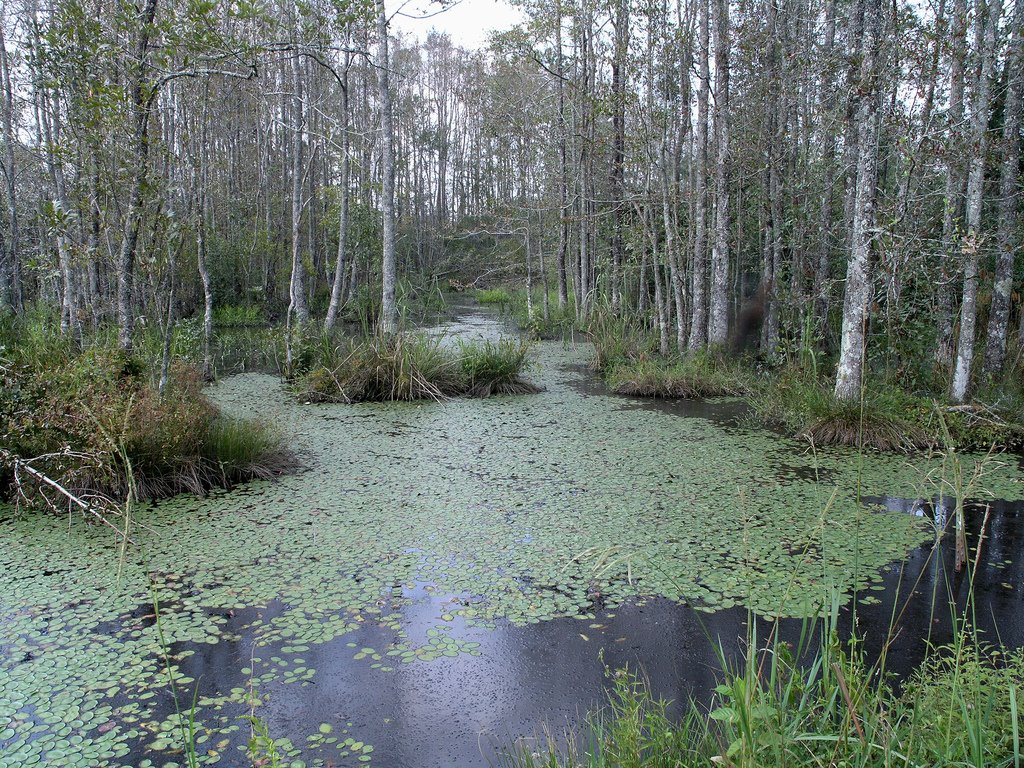 Wetlands are among the most productive habitats on earth providing shelter and nursery areas for commercially and recreationally important animals like fish and shellfish, as well as wintering grounds for migrating birds. Louisiana contains 40 percent of the coastal wetlands in the lower 48 States and for the last 50 years has lost an average of 34 square miles a year. The 2005 hurricane season greatly intensified this loss. The change from land to water in all of coastal Louisiana from 2004 to 2005 was 118.2 square miles, almost 25% of the land loss projected to occur over a period of 50 years (2000 - 2050) by the Louisiana Coastal Area Ecosystem Restoration Study.
EMIP is working with academic universities to replant marsh and wetland areas from the Louisiana Gulf Coast to the Florida Everglades. For $15.00, a tree (cypress, water oak, button brush, etc.) can be produced in a nursery, shipped to a project location and planted in a restoration project. You can help. Whether your donation is enough for a tree or a whole forest, you can do your part to protect and reclaim this vital piece of our environment.
Every cent of every donation goes directly to producing a tree.
If you would like, you can donate now. 
 Cypress seedlings in an EarthMark nursery greenhouse.
  Cypress trees in pots at an EarthMark nursery.
Saturday, September 30, 2006
How You Can Help
Wetlands are among the most productive habitats on earth providing shelter and nursery areas for commercially and recreationally important animals like fish and shellfish, as well as wintering grounds for migrating birds. Louisiana contains 40 percent of the coastal wetlands in the lower 48 States and for the last 50 years has lost an average of 34 square miles a year. The 2005 hurricane season greatly intensified this loss. The change from land to water in all of coastal Louisiana from 2004 to 2005 was 118.2 square miles, almost 25% of the land loss projected to occur over a period of 50 years (2000 - 2050) by the Louisiana Coastal Area Ecosystem Restoration Study. EMIP is working with academic universities to replant marsh and wetland areas from the Louisiana Gulf Coast to the Florida Everglades. For $15.00, a tree (cypress, water oak, button brush, etc.) can be produced in a nursery, shipped to a project location and planted in a restoration project. You can help. Whether your donation is enough for a tree or a whole forest, you can do your part to protect and reclaim this vital piece of our environment.
Every cent of every donation goes directly to producing a tree.
If you would like, you can donate now.
Cypress seedlings in an EarthMark nursery greenhouse. Cypress trees in pots at an EarthMark nursery.
Subscribe to:
Posts (Atom)