Wednesday, April 16, 2014

We all need to realize what a MAJOR rip off this is. If a mobster pulled a sunt like this he would be arrested for rackatering!

Social Security, Treasury target taxpayers for their parents’ decades-old debts

Evelyn Hockstein/For The Washington Post - Mary Grice of Takoma Park, MD, talks with her attorney Robert Vogel, at Vogel's home in Rockville Maryland, April 5, 2014.


A few weeks ago, with no notice, the U.S. government intercepted Mary Grice’s tax refunds from both the IRS and the state of Maryland. Grice had no idea that Uncle Sam had seized her money until some days later, when she got a letter saying that her refund had gone to satisfy an old debt to the government — a very old debt.
When Grice was 4, back in 1960, her father died, leaving her mother with five children to raise. Until the kids turned 18, Sadie Grice got survivor benefits from Social Security to help feed and clothe them.
Video
 
If you're one of the millions of Americans using your tax refund like a "forced savings account," here's why you shouldn't—with marshmallow Peeps to help explain. Michelle Singletary contributed to this video.
Video
 
The IRS has seen plenty of excuses from people trying to get out of paying their taxes. Jackie Kucinich takes a look at the agency's own list of creative ways folks have tried to dodge tax day.
Now, Social Security claims it overpaid someone in the Grice family — it’s not sure who — in 1977. After 37 years of silence, four years after Sadie Grice died, the government is coming after her daughter. Why the feds chose to take Mary’s money, rather than her surviving siblings’, is a mystery.
Across the nation, hundreds of thousands of taxpayers who are expecting refunds this month are instead getting letters like the one Grice got, informing them that because of a debt they never knew about — often a debt incurred by their parents — the government has confiscated their check.
The Treasury Department has intercepted $1.9 billion in tax refunds already this year — $75 million of that on debts delinquent for more than 10 years, said Jeffrey Schramek, assistant commissioner of the department’s debt management service. The aggressive effort to collect old debts started three years ago — the result of a single sentence tucked into the farm bill lifting the 10-year statute of limitations on old debts to Uncle Sam.
No one seems eager to take credit for reopening all these long-closed cases. A Social Security spokeswoman says the agency didn’t seek the change; ask Treasury. Treasury says it wasn’t us; try Congress. Congressional staffers say the request probably came from the bureaucracy.
The only explanation the government provides for suddenly going after decades-old debts comes from Social Security spokeswoman Dorothy Clark: “We have an obligation to current and future Social Security beneficiaries to attempt to recoup money that people received when it was not due.”
Since the drive to collect on very old debts began in 2011, the Treasury Department has collected $424 million in debts that were more than 10 years old. Those debts were owed to many federal agencies, but the one that has many Americans howling this tax season is the Social Security Administration, which has found 400,000 taxpayers who collectively owe $714 million on debts more than 10 years old. The agency expects to have begun proceedings against all of those people by this summer.
“It was a shock,” said Grice, 58. “What incenses me is the way they went about this. They gave me no notice, they can’t prove that I received any overpayment, and they use intimidation tactics, threatening to report this to the credit bureaus.”
Grice filed suit against the Social Security Administration in federal court in Greenbelt this week, alleging that the government violated her right to due process by holding her responsible for a $2,996 debt supposedly incurred under her father’s Social Security number.
Social Security officials told Grice that six people — Grice, her four siblings and her father’s first wife, whom she never knew — had received benefits under her father’s account. The government doesn’t look into exactly who got the overpayment; the policy is to seek compensation from the oldest sibling and work down through the family until the debt is paid.
The Federal Trade Commission, on its Web site, advises Americans that “family members typically are not obligated to pay the debts of a deceased relative from their own assets.” But Social Security officials say that if children indirectly received assistance from public dollars paid to a parent, the children’s money can be taken, no matter how long ago any overpayment occurred.
“While we are responsible for collecting delinquent debts owed to taxpayers, we understand the importance of ensuring that debtors are treated fairly,” Treasury’s Schramek said in a statement responding to questions from The Washington Post. He said Treasury requires that debtors be given due process.
Social Security spokeswoman Clark, who declined to discuss Grice’s or any other case, even with the taxpayer’s permission, said the agency is “sensitive to concerns about our attempts to arrange repayment of overpayments.” She said that before taking any money, Social Security makes “multiple attempts to contact debtors via the U.S. Mail and by phone.”
Grice, who works for the Food and Drug Administration and lives in Takoma Park, in the same apartment she’s resided in since 1984, never got any notice about a debt.
Social Security officials told her they had sent their notice to her post office box in Roxboro, N.C. Grice rented that box from 1977 to 1979 and never since. And Social Security has Grice’s current address: Every year, it sends her a statement about her benefits.
“Their record-keeping seems to be very spotty,” she said.
Treasury officials say that before they will take someone’s refund, the agency owed the money must certify the debt, meaning there must be evidence of the overpayment. But Social Security officials told Grice they had no records explaining the debt.
“The craziest part of this whole thing is the way the government seizes a child’s money to satisfy a debt that child never even knew about,” says Robert Vogel, Grice’s attorney. “They’ll say that somebody got paid for that child’s benefit, but the child had no control over the money and there’s no way to know if the parent ever used the money for the benefit of that kid.”
Grice, the middle of five children, said neither of her surviving siblings — one older, one younger — has had any money taken by the government. When Grice asked why she had been selected to pay the debt, she was told it was because she had an income and her address popped up — the correct one this time.
Grice found a lawyer willing to take her case without charge. Vogel is exercised about the constitutional violations he sees in the retroactive lifting of the 10-year limit on debt collection. “Can the government really bring back to life a case that was long dead?” the lawyer asked. “Can it really be right to seize a child’s money to satisfy a parent’s debt?”
But many other taxpayers whose refunds have been taken say they’ve been unable to contest the confiscations because of the cost, because Social Security cannot provide records detailing the original overpayment, and because the citizens, following advice from the IRS to keep financial documents for just three years, had long since trashed their own records.
In Glenarm, Ill., Brenda and Mike Samonds have spent the past year trying to figure out how to get back the $189.10 tax refund the government seized, claiming that Mike’s mother, who died 33 years ago, had been overpaid on survivor’s benefits after Mike’s father died in 1969.
“It was never Mike’s money, it was his mother’s,” Brenda Samonds said. “The government took the money first and then they sent us the letter. We could never get one sentence from them explaining why the money was taken.” The government mailed its notice about the debt to the house Mike’s mother lived in 40 years ago.
The Social Security spokeswoman said the agency uses a private contractor to seek current addresses and is supposed to halt collections if notices are returned as undeliverable.
After hours on the phone trying and failing to get information about the debt Mike’s mother was said to owe, the Samondses gave up.
After waiting on hold for two hours with Social Security last week, Ted Verbich also concluded it wasn’t worth the time or money to fight for the $172 the government intercepted last month.
In 1977, Verbich, now 57, was in college at the University of Maryland when he took a full-time job in an accountant’s office. Because he was earning income, he knew he had to give up the survivor’s benefits his mother had received since his father died, when Verbich was 4. But his $70 monthly checks — “They helped with the car payment,” he said — kept coming for a short time after he started work, and Verbich was notified in 1978 that he had to repay about $600. He did.
Thirty-six years later, with no notice, “they snatched my Maryland tax refund,” said Verbich, a federal worker who has lived at the same address in Glendale, Md,. for 30 years and regularly receives Social Security statements there. The feds insisted that he owed $172 but could provide no documents to back up the claim.
Verbich has given up on getting his refund, but he wants a receipt stating that his debt to his country is resolved.
“I’ll put in the request,” a Social Security clerk told Verbich, “but in reality, you’ll never get anything.”
Grice was also told there was little point in seeking a waiver of her debt. Collections can only be halted if the person passes two tests, Clark said: The taxpayer must prove that he “is without fault, and [that] repayment of the overpayment would deprive the person of income needed for ordinary living expenses.”
More than 1,200 appeals have been filed on the old cases, Clark said; taxpayers have won about 10 percent of those appeals.
The Treasury initially held the full amount of Grice’s federal and state refunds, a total of $4,462. Last week, after The Washington Post inquired about Grice’s case, the government returned the portion of her refund above the $2,996 owed on her father’s account.
But unless the feds can prove that she ever received any of the overpayment, Grice wants all of her money back.
“Look, I love a good fight, especially for principle,” she said. “My mom used to say, ‘This country is carried on the backs of the little people,’ and now I see what she meant. This is really sad.”

Saturday, April 05, 2014

MSN News and Global Warming


Global warming dials up our risks, UN report says


YOKOHAMA, Japan (AP) — If the world doesn't cut pollution of heat-trapping gases, the already noticeable harms of global warming could spiral "out of control," the head of a United Nations scientific panel warned Monday.
And he's not alone. The Obama White House says it is taking this new report as a call for action, with Secretary of State John Kerry saying "the costs of inaction are catastrophic."


Climate change boosts conflict risk, floods, hunger: UN report

Rajendra Pachauri, chairman of the Intergovernmental Panel on Climate Change that issued the 32-volume, 2,610-page report here early Monday, told The Associated Press: "It is a call for action." Without reductions in emissions, he said, impacts from warming "could get out of control."
One of the study's authors, Maarten van Aalst, a top official at the International Federation of the Red Cross and Red Crescent Societies, said, "If we don't reduce greenhouse gases soon, risks will get out of hand. And the risks have already risen."
Twenty-first century disasters such as killer heat waves in Europe, wildfires in the United States, droughts in Australia and deadly flooding in Mozambique, Thailand and Pakistan highlight how vulnerable humanity is to extreme weather, according to the report from the Nobel Prize-winning group of scientists. The dangers are going to worsen as the climate changes even more, the report's authors said.
"We're now in an era where climate change isn't some kind of future hypothetical," said the overall lead author of the report, Chris Field of the Carnegie Institution for Science in California. "We live in an area where impacts from climate change are already widespread and consequential."
Nobody is immune, Pachauri and other scientists said.
"We're all sitting ducks," Princeton University professor Michael Oppenheimer, one of the main authors of the report, said in an interview.
After several days of late-night wrangling, more than 100 governments unanimously approved the scientist-written 49-page summary — which is aimed at world political leaders. The summary mentions the word "risk" an average of about 5 1/2 times per page.
"Changes are occurring rapidly and they are sort of building up that risk," Field said.
AP Photo: Hadi Mizban,
Syrian refugees cross into Iraq at the Peshkhabour border point in Dahuk, 260 miles northwest of Baghdad, Iraq.
These risks are both big and small, according to the report. They are now and in the future. They hit farmers and big cities. Some places will have too much water, some not enough, including drinking water. Other risks mentioned in the report involve the price and availability of food, and to a lesser and more qualified extent some diseases, financial costs and even world peace.
"Things are worse than we had predicted" in 2007, when the group of scientists last issued this type of report, said report co-author Saleemul Huq, director of the International Centre for Climate Change and Development at the Independent University in Bangladesh. "We are going to see more and more impacts, faster and sooner than we had anticipated."
The problems have gotten so bad that the panel had to add a new and dangerous level of risks. In 2007, the biggest risk level in one key summary graphic was "high" and colored blazing red. The latest report adds a new level, "very high," and colors it deep purple.
You might as well call it a "horrible" risk level, said van Aalst: "The horrible is something quite likely, and we won't be able to do anything about it."
The report predicts that the highest level of risk would first hit plants and animals, both on land and the acidifying oceans.
Climate change will worsen problems that society already has, such as poverty, sickness, violence and refugees, according to the report. And on the other end, it will act as a brake slowing down the benefits of a modernizing society, such as regular economic growth and more efficient crop production, it says.
"In recent decades, changes in climate have caused impacts on natural and human systems on all continents and across the oceans," the report says.
And if society doesn't change, the future looks even worse, it says: "Increasing magnitudes of warming increase the likelihood of severe, pervasive, and irreversible impacts."
While the problems from global warming will hit everyone in some way, the magnitude of the harm won't be equal, coming down harder on people who can least afford it, the report says. It will increase the gaps between the rich and poor, healthy and sick, young and old, and men and women, van Aalst said.
But the report's authors say this is not a modern day version of the Four Horsemen of the Apocalypse. Much of what they warn of are more nuanced troubles that grow by degrees and worsen other societal ills. The report also concedes that there are uncertainties in understanding and predicting future climate risks.
The report, the fifth on warming's impacts, includes risks to the ecosystems of the Earth, including a thawing Arctic, but it is far more oriented to what it means to people than past versions.
The report also notes that one major area of risk is that with increased warming, incredibly dramatic but ultra-rare single major climate events, sometimes called tipping points, become more possible with huge consequences for the globe. These are events like the melting of the Greenland ice sheet, which would take more than 1,000 years.
"I can't think of a better word for what it means to society than the word 'risk,'" said Virginia Burkett of the U.S. Geological Survey, one of the study's main authors. She calls global warming "maybe one of the greatest known risks we face."
Global warming is triggered by heat-trapping gases, such as carbon dioxide, that stay in the atmosphere for a century. Much of the gases still in the air and trapping heat came from the United States and other industrial nations. China is now by far the No. 1 carbon dioxide polluter, followed by the United States and India.
Unlike in past reports, where the scientists tried to limit examples of extremes to disasters that computer simulations can attribute partly to man-made warming, this version broadens what it looks at because it includes the larger issues of risk and vulnerability, van Aalst said.
Freaky storms like 2013's Typhoon Haiyan, 2012's Superstorm Sandy and 2008's ultra-deadly Cyclone Nargis may not have been caused by warming, but their fatal storm surges were augmented by climate change's ever rising seas, he said.


And in the cases of the big storms like Haiyan, Sandy and Hurricane Katrina in 2005, the poor were the most vulnerable, Oppenheimer and van Aalst said. The report talks about climate change helping create new pockets of poverty and "hotspots of hunger" even in richer countries, increasing inequality between rich and poor.
Report co-author Maggie Opondo of the University of Nairobi said that especially in places like Africa, climate change and extreme events mean "people are going to become more vulnerable to sinking deeper into poverty." And other study authors talked about the fairness issue with climate change.
"Rich people benefit from using all these fossil fuels," University of Sussex economist Richard Tol said. "Poorer people lose out."
Huq said he had hope because richer nations and people are being hit more, and "when it hits the rich, then it's a problem" and people start acting on it.
Part of the report talks about what can be done: reducing carbon pollution and adapting to and preparing for changing climates with smarter development.
The report echoes an earlier U.N. climate science panel that said if greenhouse gases continue to rise, the world is looking at another about 6 or 7 degrees Fahrenheit (3.5 or 4 degrees Celsius) of warming by 2100 instead of the international goal of not allowing temperatures to rise more than 2 degrees Fahrenheit (1.2 degrees Celsius). The difference between those two outcomes, Princeton's Oppenheimer said, "is the difference between driving on an icy road at 30 mph versus 90 mph. It's risky at 30, but deadly at 90."
Tol, who is in the minority of experts here, had his name removed from the summary because he found it "too alarmist," harping too much on risk.
But the panel vice chairman, Jean-Pascal van Ypersele, said that's not quite right: "We are pointing for reasons for alarm ... It's because the facts and the science and the data show that there are reasons to be alarmed. It's not because we're alarmist."
The report is based on more than 12,000 peer reviewed scientific studies. Michel Jarraud, secretary general of the World Meteorological Organization, a co-sponsor of the climate panel, said this report was "the most solid evidence you can get in any scientific discipline."
Michael Mann, a climate scientist at Pennsylvania State University who wasn't part of this report, said he found the report "very conservative" because it is based on only peer reviewed studies and has to be approved unanimously.
There is still time to adapt to some of the coming changes and reduce heat-trapping emissions, so it's not all bad, said study co-author Patricia Romero-Lankao of the National Center for Atmospheric Research in Colorado.
"We have a closing window of opportunity," she said. "We do have choices. We need to act now."
___

Monday, May 19, 2008

Live Green or Die

LIVE GREEN OR DIE was the headline splashed across a recent copy of Business Week magazine. The related article was all about General Motors recent attempt to come to grips with reality. While GM has spent the last few years churning out Hummers, other car companies like Toyota, Ford and Chrysler have been developing hybrids and electric cars. With Congress tightening fuel economy regulations and gas prices passing $4 per gallon, GM has seen the light and announced the release of their electric car, the Chevrolet Volt. The Volt has been scheduled for release by 2010.

Smaller, more fuel efficient cars are becoming the must have vehicles. Ford's F150 pickup was knocked off the top seller list this past month for the first time in 17 years! What took its place? Four smaller, fuel efficient cars had higher sales: Toyota Corolla, Toyota Camry, Honda Civic and Honda Accord. It looks like prices, gas prices that is, are finally forcing consumers and manufacturers alike to realize that we must live greener.

Monday, May 12, 2008

37,000 River Restoration Projects

Currently, there are more than 37,000 river restoration projects ongoing across the United States. Over $1 billion is spent annually to help combat the years of abuse that our country's rivers have endured. Water pollution, overconsumption, development and deforestation are just a few of the things that have led to a serious need to nurse our river systems back to health.

An integral part of almost all river restoration projects is the planting of native trees, bushes and grasses to protect river banks, provide food and shelter for wildlife, slow runoff waters to reduce flooding risks and purify runoff waters before they reach an open channel condition and are carried downstream. EMIP hopes to become a leader in providing hearty trees and plants and generating innovative planting and protection techniques for these fragile, life-giving systems.

During the 1800s, gold was the most sought after commodity in the Western United States. Today, water is probably more precious than gold. The term "Water Wars" is not unfamiliar to the inhabitants of the West. During years of drought, the same battles have been fought in the Southeastern United States. In 2007, Lake Lanier in northern Georgia reached record lows after 50 years of operation and many rivers and streams ran low or dry throughout the year.

Wednesday, April 16, 2008

2,843 Miles Per Gallon

With gas prices soaring in the direction of $4.00 per gallon, wouldn't everyone love a car that gets 2,843 mpg? Well, students from Mater Dei High School of Evansville, IN have one. Their three-wheeled, combustion-engine vehicle won the grand prize and set a new mileage record at the 2008 Shell Eco-marathon Americas held at the California Speedway in Fontana, CA. The kids from Mater Dei beat out teams from three other high schools and 23 universities from the U.S., Cananada and Mexico.

The event included categories for vehicles powered by combustion engines, fuel cell/hydrogen technology, diesel fuel, LPG (liquid petroleum gas) and solar power (event rules exclude solar powered vehicles from grand prize eligibility). The winning mileage rates for each category were as follows; combustion engines - 2,843 mpg, fuel cell/hydrogen technology - 1,668 mpg, diesel fuel - 304 mpg, LPG - 163 mpg and solar power - 2,861 mpg.

Let's hope that these innovative young people begin working for the automobile industry very soon.

Friday, March 14, 2008

Blue-Green Collar

The Blue Green Alliance is a group that was formed by the United Steelworkers union and the Sierra Club in 2006 . The group's focus is promoting job creation through the development of cleaner, renewable energy sources. They see these "green" jobs as a way to revitalize the manufacturing industry with an anticipated 850,000 new jobs like the ones created by Vestas, the world's largest wind-turbine maker, opening their blade factory in Colorado. It is the companies first U.S. plant.

Wednesday, January 23, 2008

U.S., Environmental Lagger

The United States ranked 39th out of 149 countries on an environmental performance list which evaluates sanitation, greenhouse gas emissions, agricultural policies, air pollution and 20 other measures. The U.S. scored an 81 out of a possible 100. The four countries at the top of the list were Switzerland, Sweden, Norway and Finland, which received scores of 87 or higher. Switzerland's high scores for greenhouse gas efficiency can be, at least partly, attributed to its use of hydroelectric power and its transportation system, which relies heavily on trains.

This list was first created in 2002 from research done by Yale and Columbia Universities. The 2007 list will be released this month at the World Economic Forum in Switzerland. Daniel Esty, one of the reports authors, notes that the U.S. received low scores on three different greenhouse gas emission categories as well as a smog indicator. Another researcher noted that a country's wealth correlated with high scores on sanitation and disease control, but low scores on greenhouse gas emissions and agricultural policies.

Monday, January 21, 2008

Reagan Remembered

Some of Ronald Reagan's more memorable quotes:

"The most terrifying words in the English language are: I'm from the government and I'm here to help."

"I have wondered at times about what the Ten Commandments would have looked like if Moses had run them through the U.S. Congress."

"The taxpayer: That's someone who works for the federal government but doesn't have to take the civil service examination."

"The nearest thing to eternal life we will ever see on this earth is a government program."

"Government's view of the economy could be summed up in a few short phrases: If it moves, tax it. If it keeps moving, regulate it. And if it stops moving, subsidize it."

"No arsenal, or no weapon in the arsenals of the world, is as formidable as the will and moral courage of free men and women."

"If we ever forget that we're one nation under God, then we will be a nation gone under."

Thursday, January 17, 2008

Wetlands Restoration Could Reduce Dead Zone

The Gulf of Mexico at the mouth of the Mississippi River has a dead zone of approximately 975 square miles. That would cover 80% of the state of Rhode Island. This dead zone is an area of low-oxygen water created by extreme amounts of nutrients such as phosphorus and nitrogen. These nutrients typically come from fertilizers applied to farm fields and lawns which are then washed into the Mississippi River and flushed directly into the Gulf of Mexico. The nutrients rob the water of oxygen making it unsuitable for plants and animals in an area that makes up a large portion of the nations fishing grounds.

As wetlands are lost, this dead zone grows. Wetlands typically filter out these excess nutrients and provide fresh, oxygen-rich water to the Gulf of Mexico; however, Louisiana is losing a football field of wetlands every 38 minutes. Researchers are working furiously to restore balance to this fragile ecosystem. Wetlands are being developed upstream of the Gulf Coast to help reduce nutrient loads entering the Mississippi River and restoration efforts abound along the coast. Rebuilding wetlands along Louisiana's coast not only benefits water quality, but also provides invaluable hurricane protection by reducing storm surge and, in turn, reducing potential stresses on levees.

Tuesday, January 15, 2008

Sewage Restores Wetlands

Dr. Gary Shaffer, an environmental scientist at Southeastern Louisiana University, is working toward restoring Louisiana's wetlands...using sewage. Sewage from the city of Hammond is treated and then piped seven miles to an area known as 4-Mile Marsh. The sewage effluent is clean, but still high in nutrients such as phosphorus and nitrogen. The wastewater is released into the marsh where cypress trees, tupelo trees, grasses and other plants absorb the nutrients. Approximately one month after wastewater is released from the pipline, it leaves the marsh system cleaner than it used to leave the treatment plant.

The Hammond pipeline cost $7 million, but saves the city $2 million a year by eliminating the final stage of sewage treatment. 4 million gallons per day of sewage effluent are pumped into 4-Mile Marsh. The nutrients feed the wetland plants and the plants clean the water. It's a perfect symbiotic relationship.

Numerous experiments are being conducted at 4-Mile Marsh to determine the most effective techniques for restoring the coastal wetlands. Plant species, growth techniques and plant spacing are all being tested. EMIP® cypress trees were planted alongside bare root and container grown trees in the spring of 2007 and growth and survival rates were measured after the first growing season. EMIP® cypress trees out performed the bare root and container grown trees by leaps and bounds. EMIP® cypress trees had almost 100% survival and increased in basal diameter four times more than other trees. Some EMIP® trees grew so much that they became top heavy and fell over in the wet soils; however, the ones that were righted before nutria could eat the roots seem to be recovering well. EMIP delivered 600 additional cypress trees to 4-Mile Marsh this month to be used in experiments testing the most effective tree spacing for maximum nutrient absorption.

Sewage Effluent Released into 4-Mile Marsh

Plastic Sleeves Protect Saplings in 4-Mile Marsh

Plastic Sleeves Protect Saplings in 4-Mile Marsh

EMIP® Cypress Trees Delivered for Placement in 4-Mile Marsh

Sunday, January 06, 2008

Lesson Learned?

On August 29, 2005, Hurricane Katrina hit the Gulf Coast. Two and a half years later, have we learned any lessons? Hopefully, the next administration will promote the restoration of the wetlands to help prevent this from happening again.


Thursday, January 03, 2008

2007 - The "Green" Year

Green was the color for 2007. Consumers converted to compact florescent lightbulbs and hybrid cars, corporate america reduced greenhouse gas emissions before legislation required reductions and politicians rallied around solutions to global warming. Green even moved into the world of rock with Al Gore's first ever Live Earth concert intended to raise awareness of environmental issues. The question is, will these trends continue?

In December, Congress passed the first increase in Corporate Average Fuel Economy standards in thirty years. Automakers will have to produce cars and light trucks which get an average of 35 miles per gallon by 2020, up from the current standard of 27.5. Congress is also working to pass a bill cutting greenhouse gas emissions. We may even see the environment appear in upcoming presidential debates.

Sunday, May 13, 2007

Rainforest Woes

The Ugandan government is attempting to give 17,500 acres of rainforest the axe. Literally. They intend to revoke the protected status of a portion of the Mabira Forest and give the land to a sugar cane company for clearing. Only about 15% of Uganda's land is still forested and approximately 2% of those forests are lost each year to clearing for farming and cattle. The forests mean life to the locals, providing firewood, charcoal, herbal medicine, edible fruits and timber. A recent study has shown that nine species of wildlife found only in the Mabira Forest, including a shrub used to treat malaria, would be in danger of extinction.

The rainforest is already disappearing at an alarming rate without government's actually offering up protected areas for deforestation. If only 15% of the entire country is forested, there shouldn't there be plenty of places that are already cleared and suitable for sugar cane?

Saturday, May 12, 2007

Green Rebuilding Efforts

A rebuilding project in New Orleans' Lower Ninth Ward is focusing on green techniques. Global Green USA is the environmental group building the project, which is being largely funded by the Home Depot Foundation. The project consists of five shotgun style homes and an 18-unit housing complex that will utilize 40% less energy than traditional buildings. Project sponsors and supporters hope that this can be seen as a template for other rebuilding efforts.

Tuesday, May 01, 2007

Living Rivers

You can't fight Mother Nature. For years, people have tried to make nature conform to their needs and desires; often times with disasterous consequences. Nowhere is this mindset more evident than in rivers and streams. People have moved, straightened, widened, deepened and bound waterways for a multitude of reasons, but to prevent flooding has always been near the top of the list. They seem to forget that floodplains were aptly named because rivers need to flood.

Rivers are a living, dynamic system to which flooding is like breath. The rivers may not take a breath as often as we humans do, but without it they too will certainly choke. Flooding releases sediment to the floodplains that would otherwise fill river beds. Flooding also provides nutrients to floodplain soils and replenishes wetlands. A healthy river is considered to be in a state of dynamic stability. It lives in a fairly definable corridor, within which meanders migrate, cutoff and reform as water and sediment are carried downstream.

I wish more people appreciated the natural beauty of a river. From headwaters to outlet, it maintains a delicate balance of flow and sediment and nourishes so many adjacent habitats. The studies of river hydraulics and geomorphology have allowed us to begin to understand the complex interactions of this system. Great researchers in this field, such as Luna B. Leopold and Dave Rosgen, have brought us closer to the goal of living with rivers instead of against them.

Monday, April 30, 2007

Trees Have Monetary Value

Some people have always known that trees have value, but now a dollar value has been put on them.

Now, for the first time, the [New York City] Parks Department can actually translate the value of the city’s trees into real dollars and cents. And as expected, it’s a big number.

Step 1 was a tree census, a two-year process that sent more than 1,000 volunteers to count every tree on every street in the [New York] city. The census results were then fed into a computer program that spit out a dollar value for each of the 592,130 trees counted, a figure that does not include the roughly 4.5 million trees in parks and on private land.

The program, called Stratum, was developed by researchers at the University of California at Davis and the United States Forest Service. It takes into account several factors, including a tree’s impact on local property values, its contribution to cleaning the air by absorbing carbon dioxide, and how much its shade helps reduce energy consumption.

Factoring in the costs associated with planting and upkeep, New York City’s street trees provide an annual benefit of about $122 million, according to the Parks Department. The study concludes that New York receives $5.60 in benefits for every dollar spent on trees.

Considering the enhanced root system of EMI trees absorbs 18x more carbon dioxide than other trees, I'd like to see their benefit / cost ratio.

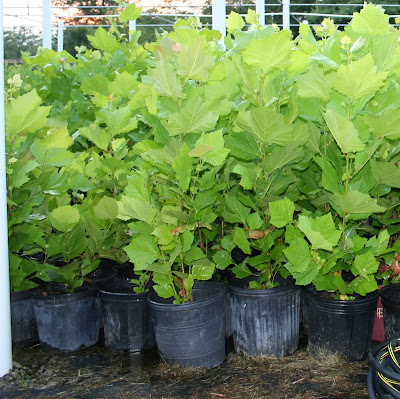
EMI Sycamore Trees Ready for Planting

Saturday, April 28, 2007

Amazon Versus Chevron

Approximately 30,000 Amazonian Indians and settlers are suing Chevron Corp. for failing to clean up billions of gallons of wastewater in Ecuador. Texaco Petroleum Co., which merged with Chevron in 2001, spent 30 years drilling for oil and dumping more than 18 billion gallons of oily wastewater in the rainforest.

The Indians are claiming that the oil company caused 30 times more damage than the Exxon Valdez oil spill, for the lands are now too oily to cultivate and cancer rates are elevated. They claim that when Texaco ceased drilling operations, their cleanup consisted of simply dumping dirt over contaminated soil and ponds. Chevron's lawyers claim that all cleanup efforts complied with Ecuadorean environmental laws.

The case is currently being heard in an Ecuadorean court after 10 years of failure to get Big Oil in a US court. Chevron has flat refused to settle out of court and a decision is not expected before next year.

Wednesday, April 25, 2007

Longleaf Pine Restoration

The US Army Corps of Engineers at Allatoona Lake has revived a natural ecosystem that was once native to the land surrounding the lake. Due to farming on the land prior to creation of the lake, the Longleaf pine ecosystem was transformed to a forest of more aggressive Loblolly and Virginia pines. Longleaf pine offers more benefits to wildlife and, in fact, offers such diversity that it serves as host to unique communities of plants and wildlife. Corps of Engineers personnel removed the competing pines and recreated the natural ecosystem through replanting and emulating wildfire. This undertaking took place on approximately 60 acres of the Allatoona Wildlife Management Area in Cherokee County near the border of Bartow County and has been so successful that the restoration will be expanded to almost 350 acres.


While this project is great for Allatoona Lake, it will hardly make a dent in the millions of acres of longleaf pine ecosystem that have been lost in the last 50 years. Many other parks and refuges are also planning longleaf pine restorations.
Sunday, April 22, 2007

Earth Day 2007

Happy Earth Day!

Did you do anything green today?

Thursday, April 19, 2007

Fly Green

Delta Airlines joins the numerous companies that are going green. Delta's Force for Global Good program allows customers to add a donation to any ticket purchase that will fund tree planting projects in managed forests around the world to offset carbon emissions. 100 percent of donations will be disbursed to the Conservation Fund's Carbon Sequestration Program. To date, the Conservation Fund has restored 30,000 acres with 9 million trees.